
In class 8 we spent a big ole chunk of time talking about AI and it’s impacts, whether that be in education, socially, or environmentally.
While I appreciate the ease of use and practicality of AI, especially within the realm of education (lets be honest, lesson planning seems like the most time consuming thing in the world), I find that there is a serious lack of critical thinking skills when it comes to whether or not we even choose to use AI (let alone critical thinking skills about the info AI spits out).
There are serious environment impacts on the use of AI that is barely spoken about, let alone understood. So before we all jump in head first into using AI, shouldn’t we be very cautious and aware of it’s environment impacts during a climate crisis?
Many professionals in the field of the environmental impacts of AI don’t even know how to properly assess these impacts! Its wild to think of how much the use of AI has grown in such a short amount of time, and we don’t know how large of an impact it has on our living world.
While information is available about AI’s high use of cold water to cool down the processors, or about the increased use of diesel generators to protect the grid due to the extreme fluctuations in energy consumption, or the fact that Chat GPT uses 5 times more energy than a simple web search (https://news.mit.edu/2025/explained-generative-ai-environmental-impact-0117), it seems as though the environmental impacts of AI are hard to even know how to measure,
On The UN agency for digital technologies website, they published an article discussing if even know how to measure AI’s environmental impacts. Their key findings from a report on the gaps in current measurements of AI environmental impact are as follows:
“Over-reliance on estimates– real-time, empirical data is rarely used, leading to inaccuracies
Underreported lifecycle phases: supply-chain impacts remain underexplored
Opaque water-use and infrastructure impacts: water consumption in data centres are poorly tracked
Lack of standardized methodologies: Existing tools and methodologies for AI impact measurement are fragmented and inconsistent
Carbon-centric metrics: Environmental assessments neglect broader impacts associated with technology growth, such as biodiversity loss, electronic waste, resource depletion and resource contention.”
If we really want to integrate the First Peoples Principles of Learning into our own education and the education of future generations, shouldn’t we be thinking critically about the environmental impacts of the use of AI?
Here are some sections of the First Peoples Principles of Learning to think about when it comes to our use of AI and it’s environmental impacts:
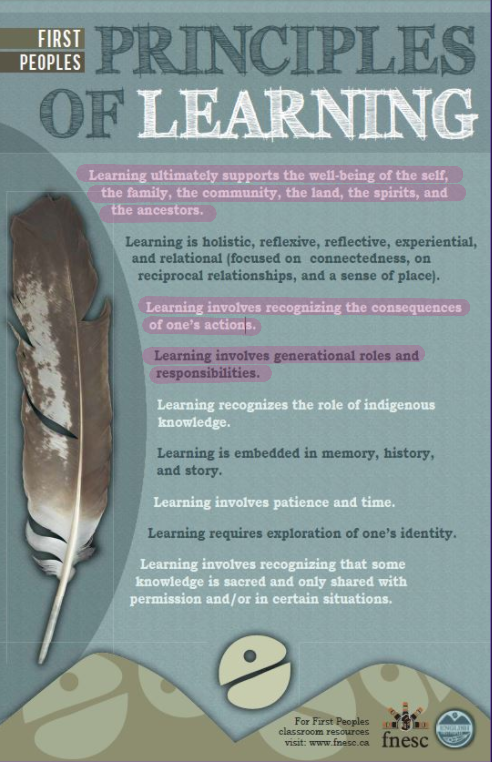
Does my use of AI support the well-being of the land?
Do I realize the consequences of my actions when it comes to the environmental impact of AI?
Am I teaching a mentality of providing a healthy environment for future generations considering the negative impact of AI use on the natural world?
Now what? Well, that’s a hard one. I’m not sure that there is an ethical way to use AI right now. Its simply being overused with a lack of regulations and restrictions. There is nothing in the world that is bottomless. I plan on being intentional and limited with my use of AI.